OEM vs third-party batteries, voltage matching, cell quality, BMS safety, and what to check before buying a replacement e-bike battery.
Every e-bike battery degrades over time. After 500–1,000 charge cycles (3–7 years of typical use), capacity drops enough that range becomes a problem. Here is how to choose the right replacement battery.
When to Replace
Signs of a Dying Battery
- Reduced range: you used to get 50 km per charge, now you get 30. This is the most obvious sign.
- Slower charging: the battery takes longer to reach full charge, or the charger's indicator light behaves erratically.
- Sudden power drops: the battery shows 40 % charge but cuts out as if empty. Cell imbalance causes this — some cells are dead while others are fine.
- Physical signs: swelling (the case bulges), unusual heat during charging, a burning smell. Stop using the battery immediately if any of these occur — it is a fire risk.
Capacity Test
If you want to measure actual capacity rather than guessing:
- Fully charge the battery
- Ride at a consistent speed on flat terrain until the battery dies
- Note the distance
- Compare to the distance you got when the battery was new (or the manufacturer's rated range at the same assist level)
If you are getting less than 60 % of the original range, the battery is due for replacement.
OEM vs Third-Party Batteries
OEM (Original Equipment Manufacturer)
The same battery the bike came with, from the same manufacturer or motor system supplier (Bosch, Shimano, Yamaha, Bafang).
Advantages:
- Guaranteed compatibility with the motor, controller, and charger
- BMS (Battery Management System) is matched to the motor's communication protocol
- Warranty coverage from the manufacturer
- Identical form factor — fits the bike perfectly
Disadvantages:
- Expensive ($600–$1,500 for most brands)
- Limited capacity options (you get what the manufacturer offers for your model)
- May be discontinued if the bike is older
Third-Party Batteries
Aftermarket batteries from specialist suppliers (e.g., Unit Pack Power, EM3EV, or local Australian battery builders).
Advantages:
- Cheaper ($300–$800 for equivalent capacity)
- Custom capacity — you can upgrade to a larger battery than the original
- Available for older bikes where OEM batteries are discontinued
Disadvantages:
- Compatibility is not guaranteed — the BMS, voltage, connector, and communication protocol must match your motor system
- Quality varies widely — cheap cells, poor BMS design, and unsafe construction are real risks with no-name brands
- No manufacturer warranty for the motor if a third-party battery damages it
- May not fit the bike's battery mount perfectly (different dimensions, different locking mechanism)
Which to Choose
For Bosch, Shimano Steps, and Yamaha systems: buy OEM. These motors use proprietary communication protocols between the battery BMS and the motor controller. A third-party battery that does not speak the protocol will not work — or will trigger error codes and reduced performance.
For Bafang systems: OEM is safest, but Bafang's protocol is well-documented and many third-party batteries work correctly. If you go third-party, buy from a supplier with confirmed Bafang compatibility.
For generic hub motor systems (no-name or budget brands): the motor usually does not communicate with the BMS. Any battery with the correct voltage, connector, and mounting will work. Third-party is a reasonable choice here.
Battery Specifications: What Matters
Voltage (V)
The battery voltage must match the motor controller's input voltage.
- 36 V systems: common on city and commuter e-bikes
- 48 V systems: common on performance and off-road e-bikes
- 52 V systems: some aftermarket and high-performance builds
Never use a battery with a different voltage than your system. A 48 V battery on a 36 V controller will damage the controller. A 36 V battery on a 48 V system will not provide enough power and may trigger low-voltage errors.
Capacity (Ah and Wh)
- Ah (amp-hours): how much charge the battery holds. Higher Ah = more range.
- Wh (watt-hours): the true measure of energy. Wh = V × Ah. A 36 V 14 Ah battery is 504 Wh. A 48 V 14 Ah battery is 672 Wh. Same Ah, different energy.
Always compare Wh, not Ah, when evaluating batteries. Wh tells you how much energy the battery holds regardless of voltage.
Cell Quality
Lithium-ion batteries are built from individual cells (usually 18650 or 21700 format). Cell quality determines:
- Capacity retention: good cells (Samsung, LG, Panasonic, Molicel) retain 80 % capacity after 500–800 cycles. Cheap cells may drop to 60 % after 300 cycles.
- Safety: good cells have consistent chemistry and reliable pressure vents. Cheap cells can overheat, swell, or catch fire.
- Discharge rate: good cells deliver consistent power even at low charge levels. Cheap cells sag under load, causing sudden power drops.
Top-tier cells: Samsung 35E, Samsung 40T, LG MJ1, Panasonic NCR18650GA, Molicel P42A Avoid: no-name cells with no datasheet, cells claiming capacities that exceed known chemistry limits (e.g., an 18650 cell claiming 5000 mAh — the theoretical max is ~3600 mAh)
BMS (Battery Management System)
The BMS is the battery's brain. It monitors cell voltage, temperature, and current, and protects against:
- Overcharging (stops charging when full)
- Over-discharging (cuts off when empty to prevent cell damage)
- Overcurrent (limits discharge current to protect cells)
- Short circuit (immediate cut-off)
- Temperature (reduces power or shuts down if too hot or cold)
- Cell balancing (equalises charge across cells so no cell is overworked)
A cheap BMS cuts corners on balancing and temperature monitoring — leading to premature cell failure and safety risks.
Connector
The battery connector must physically match the bike's wiring. Common connectors:
- Anderson Powerpole: common on aftermarket and Bafang systems
- Higo / Hailong: common on Chinese hub motor systems
- Bosch / Shimano proprietary: specific to each motor brand, not interchangeable
- XT60 / XT90: common on DIY and conversion kit builds
If the connector does not match, an adapter can be made — but this adds a potential point of failure (loose connections, voltage drop, water ingress).
Physical Fit
Frame-Integrated Batteries
Most modern e-bikes have the battery integrated into the downtube or seat tube. Replacement batteries must match the exact form factor — length, width, height, and mounting mechanism.
OEM advantage: guaranteed to fit. Third-party may require modification or may not fit at all.
Rack-Mounted Batteries
Batteries mounted on the rear rack are easier to replace — the rack interface is more standardised. However, rack batteries shift the bike's weight rearward, affecting handling.
External Frame Batteries (Hailong / Shark Pack)
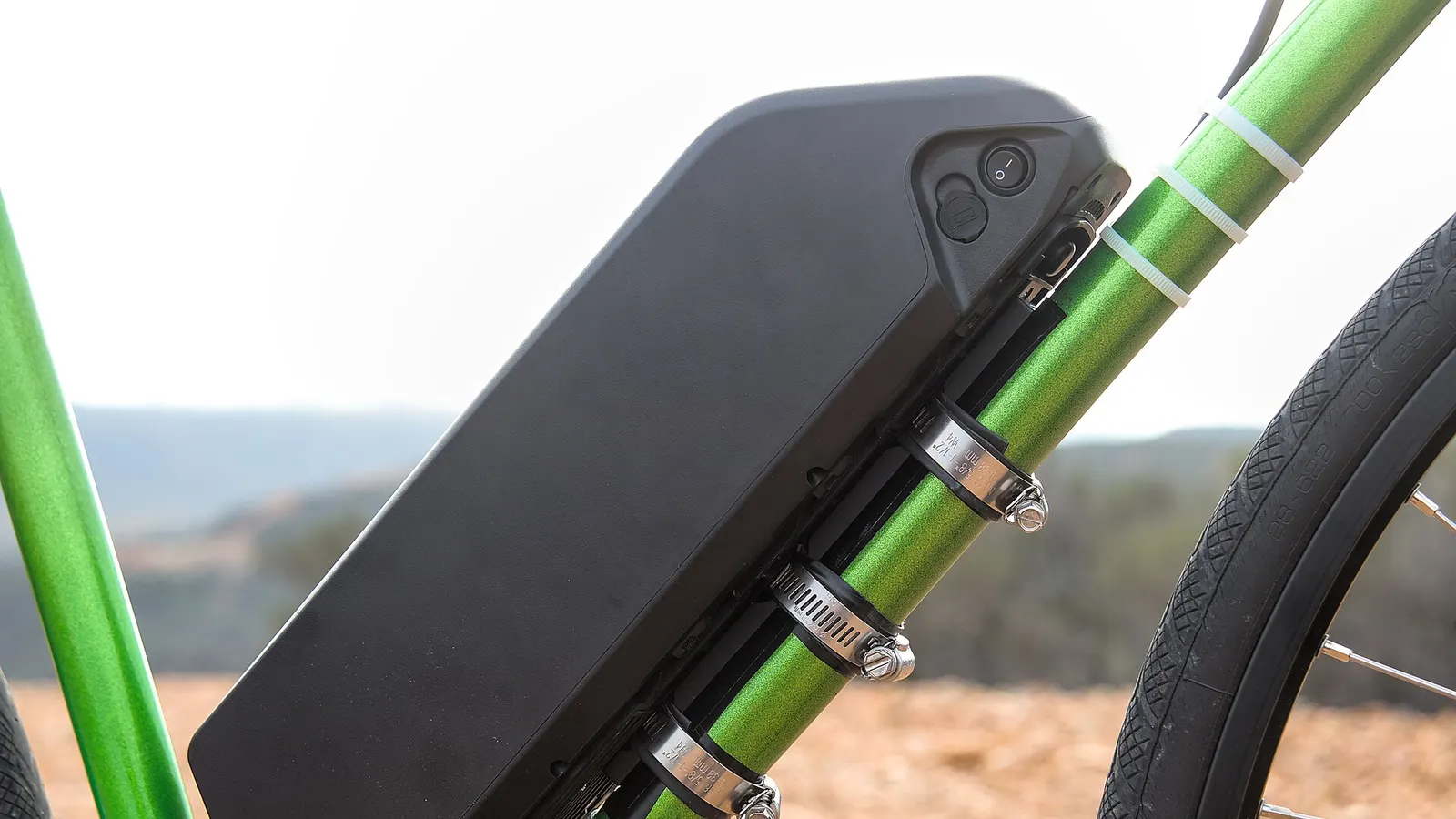
Common on conversion kits and budget e-bikes. These mount to bottle cage bosses on the downtube. Replacement is straightforward — many aftermarket options fit the standard mounting bracket.
Buying Tips
- Record your current battery's specs before shopping: voltage, capacity (Wh), physical dimensions, connector type, and mounting system.
- Buy from a reputable supplier with a return policy and warranty (minimum 12 months).
- Check the cell brand — ask the supplier which cells are used. If they cannot or will not tell you, do not buy.
- Buy from an Australian supplier if possible — Australian Consumer Law applies, and shipping lithium batteries internationally is restricted and expensive.
- Do not buy the cheapest option. A $200 battery with no-name cells and a poor BMS is a fire risk and will need replacing again in 1–2 years.
- Keep the old battery for recycling at a battery drop-off point (most bike shops and Aldi/Bunnings accept lithium batteries). Do not put it in household waste.
Bottom Line
When your e-bike battery degrades below 60 % of its original range, it is time to replace. Buy OEM for proprietary systems (Bosch, Shimano, Yamaha); consider quality third-party options for Bafang and generic hub motors. Match voltage exactly, compare Wh for capacity, insist on name-brand cells (Samsung, LG, Panasonic), and buy from a supplier with a warranty. A quality replacement battery costs $500–$1,200 and gives you another 3–7 years of riding.
Need Parts or Upgrades?
Find batteries, chargers, conversion kits, tyres and brakes for e-bikes, scooters and more.
Shop Batteries, Parts & Kits →