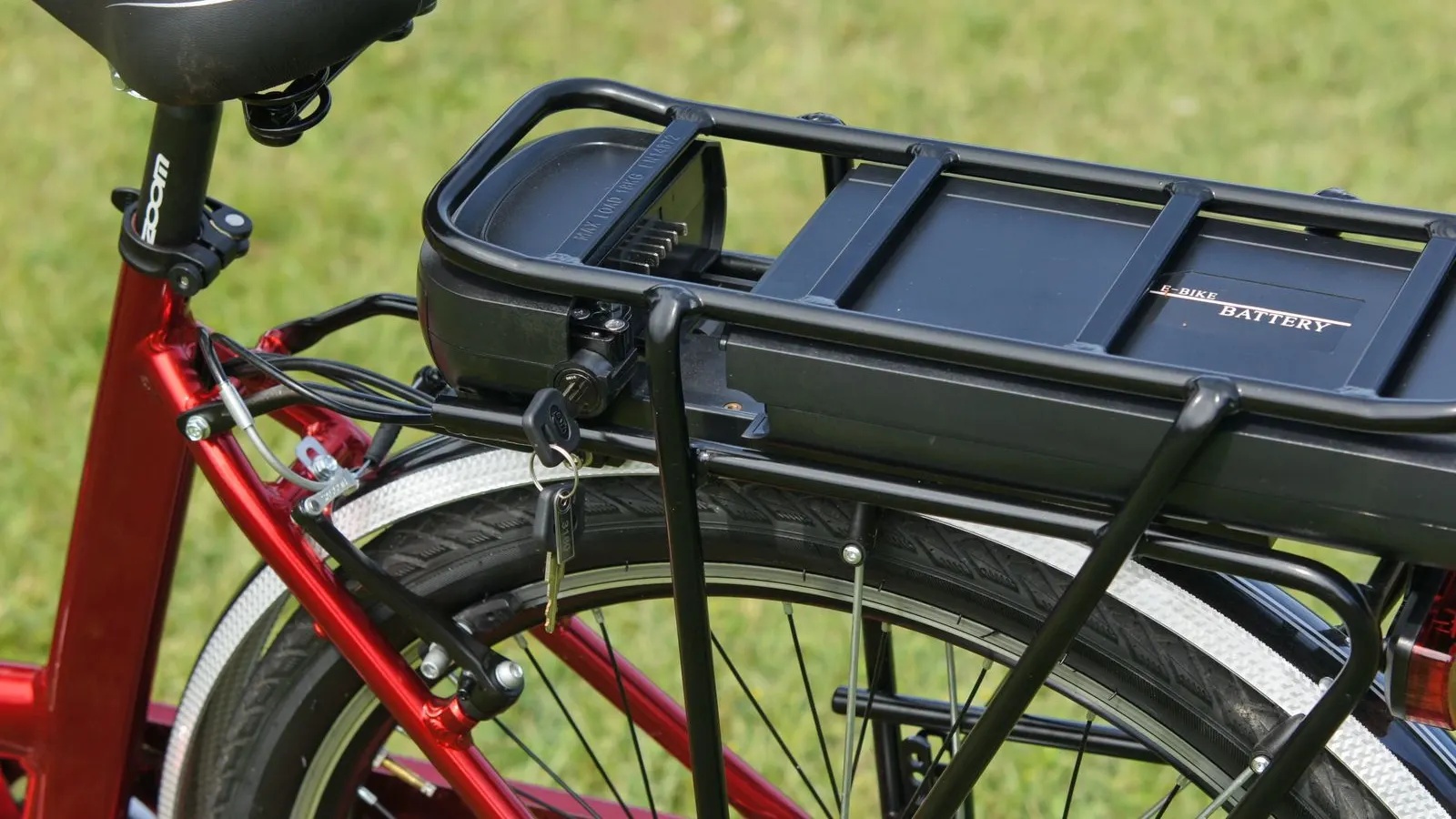
Charger types, charging times, solar charging feasibility, travel chargers, and charger safety for e-bike owners.
E-Bike Charger Guide: Standard vs Fast Charging, Solar Charging, Safety, and Travel Chargers
Your e-bike charger is the piece of equipment you use every day but probably think about least. Getting the right charger and using it correctly protects your battery, saves money, and opens up options like solar charging and travel charging. Here is what you need to know.
Standard Chargers
Every e-bike comes with a standard charger designed for the specific battery voltage and chemistry. These typically charge at 2A to 3A, meaning a full charge from empty takes four to six hours for a typical 500Wh battery.
Standard chargers are designed for overnight or workday charging. Plug in when you get home, and the bike is ready the next morning. The lower charge rate is gentler on the battery cells, producing less heat and reducing stress. For daily commuting, a standard charger is all most riders need.
Key specifications to understand on your charger:
Output voltage must match your battery. A 48V battery uses a charger with a 54.6V output (the full charge voltage for a 13S lithium-ion pack). A 36V battery uses a 42V charger. Using the wrong voltage charger can damage the battery or create a fire risk. Never mix chargers between different voltage batteries.
Output current (measured in amps) determines how fast the battery charges. A 2A charger delivers 2 amps of current. Higher amps means faster charging but more heat in the battery.
Connector type varies between manufacturers. Common connectors include the 3-pin XLR (used on many aftermarket batteries), barrel connectors of various sizes (5.5mm x 2.1mm and 5.5mm x 2.5mm are common), and proprietary connectors used by brands like Bosch, Shimano, and Specialized. The connector must match physically and in pin polarity.
Fast Chargers
Fast chargers output 4A to 8A or more, cutting charge times to one to three hours. Several situations make fast charging worth considering:
Delivery riders and gig workers who need to charge during short breaks benefit significantly from fast charging. A 5A charger can add 50 percent charge to a 500Wh battery in about an hour.
Long-distance touring where you stop for lunch and want to top up before the afternoon ride. A fast charger at a cafe can add meaningful range during a meal break.
Riders with multiple daily trips who cannot charge overnight between each ride.
The trade-off with fast charging is battery longevity. Faster charging generates more heat in the cells, and heat is the primary enemy of lithium-ion battery life. Regularly fast charging a battery will reduce its total lifecycle compared to standard charging.
A practical approach is to use a standard charger for daily overnight charging and keep a fast charger for occasions when you genuinely need the speed. Some chargers offer selectable charge rates, letting you choose 2A for overnight and 5A when you are in a hurry.
Fast chargers for e-bikes in Australia range from $100 to $300 AUD depending on the output current and build quality. Ensure any fast charger you buy is specifically designed for your battery voltage and has appropriate safety certifications.
Solar Charging
Solar charging an e-bike battery is feasible in Australia given our excellent solar resources, but there are practical limitations to understand.
Direct solar panel to battery charging is not possible without electronics in between. Solar panels output variable DC voltage that changes with sunlight conditions. You need a solar charge controller to regulate the output and a DC-DC converter to match the panel voltage to your battery's charge voltage. Some purpose-built solar e-bike chargers handle this conversion internally.
Panel size and charge time: A typical portable solar panel suitable for e-bike charging is 100W to 200W. Under ideal Australian conditions (clear sky, panel facing the sun, middle of the day), a 200W panel might deliver 150W of effective charging power. For a 500Wh battery, that is a theoretical charge time of about three to four hours, but real-world conditions (cloud, angle, temperature) typically double this.
Practical solar setups include:
- A portable folding solar panel (100W to 200W) with a compatible charge controller. Good for touring, camping, or off-grid use. Expect $300 to $600 AUD for the panel and controller.
- Charging from your home solar system. If you have rooftop solar, charging your e-bike during daylight hours effectively makes it solar powered. A 500Wh charge costs roughly 15 to 20 cents from the grid in Australia; from your solar panels, it is essentially free.
- Portable power stations (like Jackery or EcoFlow units) charged by solar panels, then used to charge the e-bike battery. This adds flexibility since the power station stores energy for charging at any time. A 1,000Wh power station costs $1,000 to $2,000 AUD and can charge a typical e-bike battery twice.
Solar charging makes the most sense for touring, remote property use, or riders who want to minimise their grid electricity consumption. For urban commuters, charging from home solar via a standard power point is the simplest and most efficient approach.
Charger Safety
Lithium-ion battery fires, while rare, do happen and are almost always related to charging. Follow these safety practices:
Use the correct charger. Never use a charger from a different voltage battery, even if the connector fits. Never use a modified or damaged charger.
Do not charge unattended overnight if you can avoid it. If you must charge overnight, place the battery and charger on a non-flammable surface (concrete floor, ceramic tile, metal tray) away from flammable materials. Some riders charge in the garage on a concrete floor rather than inside the house.
Do not charge immediately after riding. Let the battery cool for 30 minutes after a ride before plugging in the charger. Charging hot cells accelerates degradation and increases risk.
Monitor charging. Check the battery and charger periodically during charging. If either feels excessively hot (too hot to hold comfortably), unplug immediately and investigate.
Charge between 0 and 40 degrees Celsius. Australian summers can push garage temperatures above 40 degrees in many areas. Bring the battery inside to charge in a climate-controlled room if your garage gets very hot.
Inspect cables and connectors. Look for frayed wires, bent pins, scorch marks, or loose connections. Replace damaged charging equipment immediately.
Do not cover the charger or battery while charging. Both generate heat and need airflow to stay cool.
Use a smoke detector in the room where you charge. Consider a fire-retardant charging bag (available for around $30 to $80 AUD) as an extra precaution, particularly for aftermarket or older batteries.
Travel Chargers
If you travel with your e-bike, a compact travel charger is useful. Standard chargers can be bulky and heavy (some weigh over 1kg). Travel charger options include:
Compact chargers at lower amperage (1A to 2A) are physically smaller and lighter. Charging is slower, but the charger fits easily in a bag. These typically cost $60 to $120 AUD.
Universal voltage input (100V to 240V, 50/60Hz) is standard on most modern e-bike chargers, meaning they work in any country without a voltage converter. You only need a plug adapter for the wall socket. Check your charger's label to confirm before travelling internationally.
Car chargers use a 12V cigarette lighter or accessory socket to charge your e-bike battery while driving. These use an inverter to convert 12V DC to mains AC, then the standard charger plugs into the inverter. A 300W pure sine wave inverter (about $60 to $150 AUD) handles most standard e-bike chargers. This is particularly useful for road trips where you want to charge the bike while driving to the trailhead.
Airline restrictions are important to note. Most airlines prohibit lithium-ion batteries over 100Wh in checked luggage, and e-bike batteries far exceed this threshold. You generally cannot fly with an e-bike battery. If flying to a destination, you may need to ship the battery separately via ground freight or arrange a rental battery at your destination.
When to Replace Your Charger
Replace your charger if:
- It makes unusual buzzing, clicking, or whining noises
- The housing is cracked or damaged
- Cables are frayed, kinked, or the insulation is split
- Connectors show heat damage, discolouration, or corrosion
- The indicator light does not change from red to green when the battery is full
- The charger feels hotter than normal during use
A replacement charger from a reputable supplier costs $50 to $200 AUD depending on the output current and connector type. Always buy a charger rated for your exact battery voltage. When in doubt, contact the battery manufacturer or a knowledgeable supplier for the correct specification.
Need Parts or Upgrades?
Find batteries, chargers, conversion kits, tyres and brakes for e-bikes, scooters and more.
Shop Batteries, Parts & Kits →