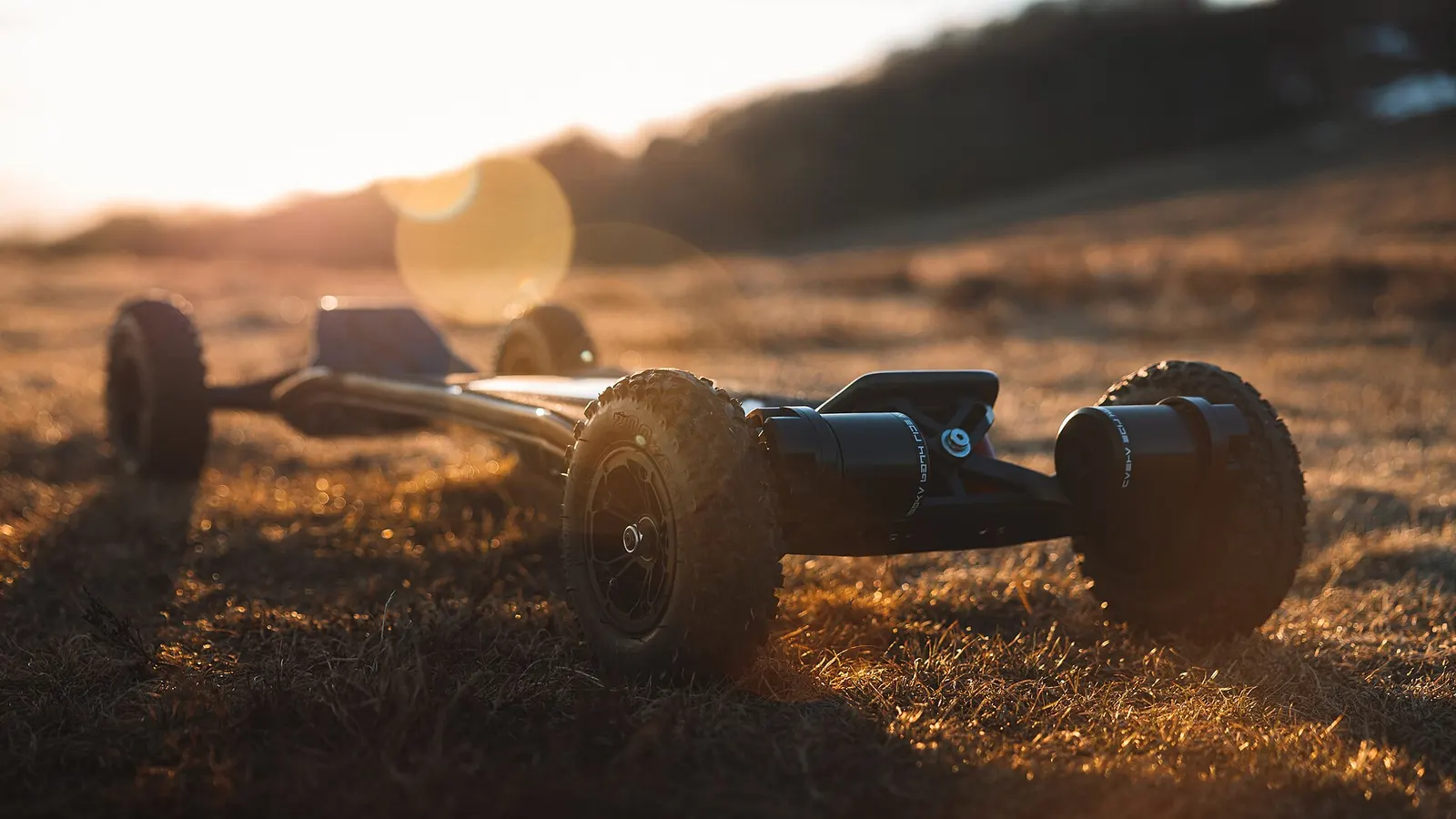
Pneumatic wheels, dual motors, and flex decks — what makes an all-terrain e-skateboard and where to ride off-road in Australia.
Standard electric skateboards work well on smooth bike paths and clean asphalt. Take them onto gravel, grass, or a dirt trail and they become useless or dangerous. All-terrain electric skateboards are built for exactly these conditions, using pneumatic tyres, beefier motors, and rugged construction to handle surfaces that would destroy a street board.
What Makes a Board All-Terrain
The defining feature is the wheels. All-terrain boards use pneumatic (air-filled) tyres, typically 150 mm (6 inches) or larger, instead of the hard polyurethane wheels found on street boards. These tyres absorb bumps, grip loose surfaces, and roll over obstacles that would stop a standard wheel dead.
Beyond the wheels, all-terrain boards differ from street boards in several ways:
Dual motors. Most all-terrain boards run dual belt-drive or dual hub motors to provide enough torque for loose surfaces and steep inclines. Single-motor setups struggle to maintain traction off-road.
Higher ground clearance. The larger wheels raise the deck further from the ground, reducing the chance of scraping the battery enclosure on rocks or uneven terrain.
Stronger trucks. All-terrain trucks are wider and more robust to handle the lateral forces of riding on uneven ground.
Larger batteries. Pneumatic tyres create more rolling resistance than urethane wheels, so all-terrain boards need bigger batteries to achieve comparable range.
Pneumatic vs Airless Tyres
Most all-terrain boards ship with pneumatic tyres. These offer the best ride quality and grip but can puncture. Carrying a small repair kit or spare tube is sensible if you ride remote trails.
Some boards offer airless or honeycomb tyres as an alternative. These eliminate puncture risk but ride noticeably harder. They are a reasonable choice for riders who stick to gravel paths and fire trails rather than rocky singletrack.
A few premium boards let you swap between pneumatic tyres for off-road use and smaller urethane wheels for street riding. This versatility is worth paying for if you plan to use the board in both environments.
Where to Ride Off-Road in Australia
Australia has excellent terrain for all-terrain electric skateboarding if you know where to look.
Fire trails and management tracks. National parks and state forests are laced with unsealed fire trails. These compacted gravel or dirt surfaces are ideal for all-terrain boards. Check local regulations, as some parks restrict motorised vehicles on trails. Whether electric skateboards fall under these restrictions is often ambiguous.
Beach paths and coastal tracks. Compacted sand paths near beaches can work well, though deep, loose sand will bog down even the best all-terrain board. Stick to the hard-packed sections.
Rural roads. Unsealed country roads in regional areas offer long, open riding. Be mindful of traffic, dust, and the fact that you are far from help if something goes wrong.
Park and reserve trails. Many suburban parks and reserves have gravel paths that are perfectly suited to all-terrain boards. These are good options for practice sessions close to home.
Avoid: Deep sand, thick mud, wet rocks, and technical mountain bike trails with drops or jumps. All-terrain electric skateboards handle rough surfaces, not obstacles that require suspension travel or the ability to lift the front wheel.
Performance Expectations
All-terrain boards sacrifice some performance metrics compared to street boards.
Speed. Most all-terrain boards top out at 30 to 40 km/h, which is comparable to many street boards. However, you will rarely hit top speed off-road. Practical riding speeds on gravel or dirt are more like 15 to 25 km/h.
Range. The combination of larger tyres, heavier weight, and rougher surfaces means all-terrain boards use more energy per kilometre. A board rated at 30 km range on the street might manage 18 to 22 km off-road, depending on the surface and terrain.
Hill climbing. This is where all-terrain boards often excel. Dual motors and grippy tyres give them strong hill climbing ability. Many can handle grades of 25 to 30 percent, which covers most hills you will encounter.
Weight. All-terrain boards are heavy. Expect 10 to 15 kg for most models, with some exceeding 15 kg. This is a real consideration for transport and carrying.
Riding Technique for Off-Road
Riding off-road requires adjustments to your technique compared to street riding.
Lower your centre of gravity. Bend your knees more than you would on the street. This helps you absorb bumps and maintain balance when the board shifts underneath you.
Shift your weight forward. On loose surfaces, keeping more weight on the front truck helps maintain steering control. If the front wheels lose traction, you lose the ability to steer.
Use lower speed modes. Off-road traction is unpredictable. A sudden burst of throttle on gravel can spin the rear wheels and throw you off. Smooth, progressive throttle application is essential.
Brake early and gently. Locking up the wheels on loose surfaces causes a slide. Apply brakes progressively and earlier than you would on the street. On steep descents, alternate between braking and coasting to manage speed without overheating the motors.
Stand relaxed. Tension in your legs and body makes you rigid, which means every bump transfers directly through your body. Stay loose and let your knees act as suspension.
Scout your line. Look ahead and choose your path through rough sections. Avoid ruts, large rocks, and sections where the surface changes abruptly. A smooth line at moderate speed beats a fast line through rough terrain.
Maintenance for Off-Road Boards
Off-road riding is harder on equipment than street riding.
Tyre pressure. Check your tyre pressure before every ride. Running slightly lower pressure (around 30 psi instead of 40 to 50 psi) improves grip and comfort off-road but increases puncture risk and rolling resistance. Find the balance that suits your terrain.
Belt inspection. If your board uses belt drives, inspect the belts after every off-road session. Gravel, sticks, and debris can nick or wear belts faster than street riding. Carry spare belts on longer rides.
Bearing cleaning. Dust and dirt work their way into bearings quickly off-road. Clean and re-lubricate bearings regularly. If you ride in muddy or wet conditions, do this after every ride.
Battery enclosure. Check that the battery enclosure seal remains intact. Dust and water ingress can damage electronics. Some riders add additional gasket material or silicone sealant for extra protection.
Truck bolts and hardware. Vibration from rough terrain loosens bolts over time. Check all hardware regularly and carry a skate tool on rides.
Cost of All-Terrain Boards in Australia
All-terrain electric skateboards cost more than their street equivalents. The larger tyres, dual motors, bigger batteries, and stronger construction all add to the price.
Entry level ($1,000 to $1,800). Basic dual-motor all-terrain boards with adequate range and build quality. Fine for gravel paths and light off-road use.
Mid-range ($1,800 to $3,000). Better components, longer range, swappable wheel options, and more refined ride characteristics. This is where most serious riders land.
Premium ($3,000+). Top-tier boards with high-capacity batteries, carbon fibre decks, premium trucks, and range exceeding 30 km off-road. These are specialist tools for committed riders.
Safety Considerations
Off-road riding carries additional risks compared to street riding.
Full protective gear. Helmet, knee pads, elbow pads, slide gloves, and closed-toe shoes with ankle support are the minimum. Consider a full-face helmet for fast trail riding.
Ride with a plan. Tell someone where you are going and when you expect to return, especially on remote trails. Carry your phone and enough water.
Know your limits. Start on easy terrain and work your way up. An all-terrain board handles more than a street board, but it does not handle everything. When in doubt, walk the section first.
All-terrain electric skateboards open up riding possibilities that street boards simply cannot reach. If your local terrain extends beyond smooth asphalt, they are worth the investment.
Ready to Roll?
Explore street and all-terrain electric skateboards and longboards, plus spare belts, wheels and chargers.
Shop Electric Skateboards →