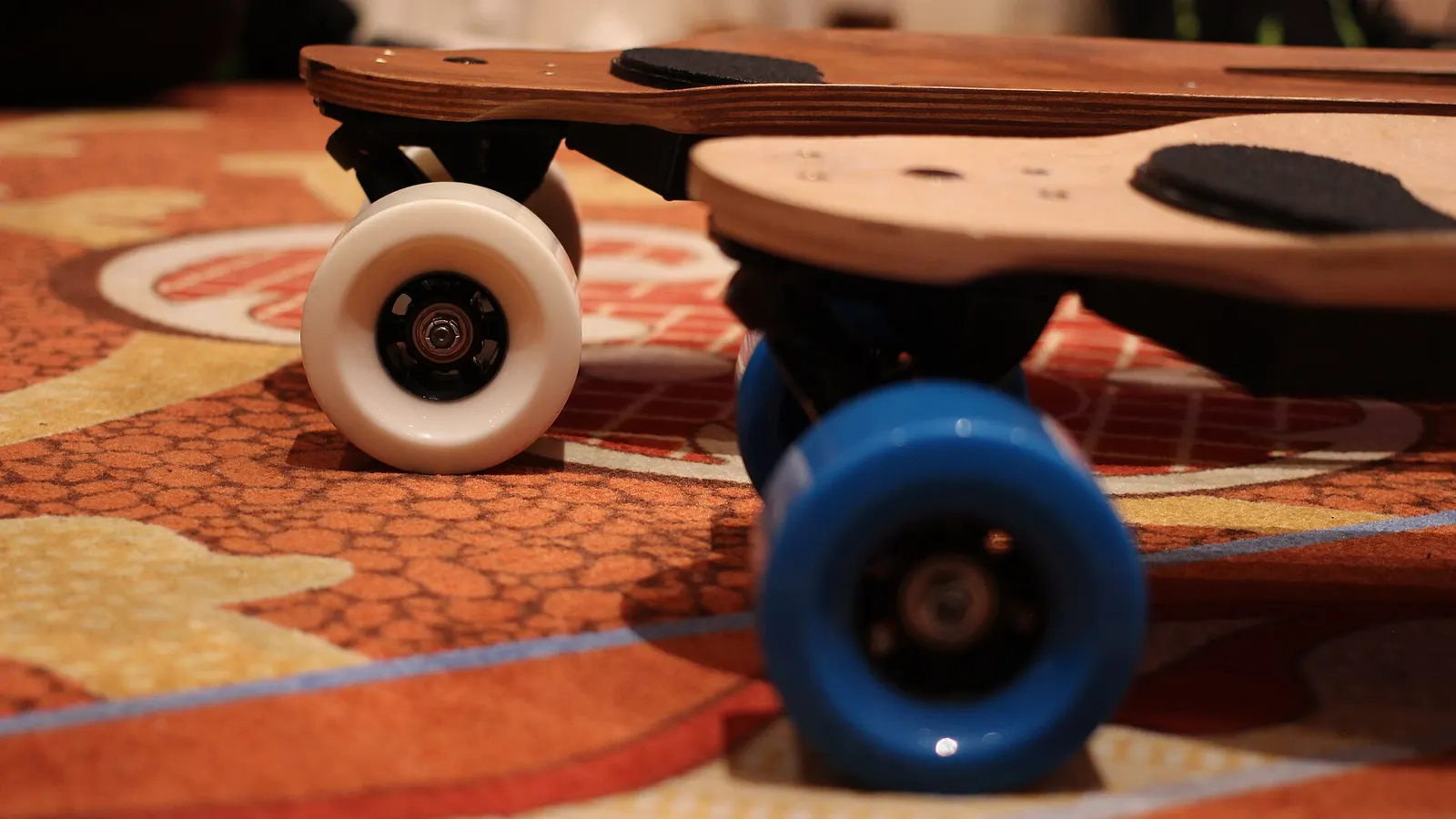
What to look for in your first electric skateboard — deck type, motor power, remote control, safety features, and Australian price ranges.
Picking your first electric skateboard can be overwhelming. The market ranges from cheap imports that fall apart in weeks to high-end boards that cost more than a decent e-bike. This guide cuts through the noise and focuses on what actually matters for Australian beginners.
What Makes a Good Beginner Electric Skateboard
A beginner board needs three things: predictable acceleration, reliable braking, and a stable deck. Everything else is secondary.
Speed modes matter more than top speed. Most decent boards offer two or three speed settings. A good beginner mode caps you at around 15 to 20 km/h, which is fast enough to be useful but slow enough that a wobble does not send you to hospital. Boards that only have one speed setting, or that jump aggressively between modes, are a poor choice for someone still finding their balance.
Deck shape and wheelbase. Longer wheelbases are more stable at speed. A deck length of around 90 to 100 cm gives you room to shift your weight without feeling cramped. Flexy bamboo or composite decks absorb road vibration better than stiff maple, which matters on the rough footpaths and bike lanes you find in most Australian suburbs.
Weight. You are going to carry this thing up stairs, onto trains, and into offices. Boards range from about 5 kg for ultralight models up to 12 kg or more for all-terrain setups. For a first board, aim for under 8 kg if portability matters to you.
Remote Controls and Ride Feel
Every electric skateboard uses a handheld remote to control speed and braking. The quality of this remote makes a massive difference to how safe the board feels.
Look for remotes with a smooth, proportional trigger or thumbwheel rather than a binary on/off button. You want to be able to feather the throttle, especially when pulling away from a stop. Some cheaper boards have a noticeable delay between trigger input and motor response, which is unsettling when you are learning.
Bluetooth connectivity between the remote and the board should be rock solid. Dropouts at speed are dangerous. Read reviews specifically mentioning connection reliability before buying.
Hub Motors vs Belt Drive
Beginner boards almost always use one of two motor types.
Hub motors are built into the rear wheels. They are quieter, require less maintenance, and coast freely when the battery dies. The trade-off is that hub motor wheels tend to be harder, which means you feel every crack and pebble. They also offer slightly weaker braking compared to belt drives.
Belt drive systems use a motor mounted to the truck with a toothed belt driving the wheel. They deliver stronger acceleration and braking, and you can swap wheel types more easily. The downsides are more noise, more maintenance (belts wear out), and the board will not roll freely if the battery dies.
For most beginners, hub motors are the simpler choice. Belt drives reward riders who want to tinker and upgrade later.
Price Ranges in Australia
Electric skateboards in Australia fall into roughly three tiers.
Budget ($400 to $800). Entry-level boards from brands you will find on Amazon or eBay. Expect a top speed around 25 km/h, range of 10 to 15 km, and basic build quality. These are fine for learning whether you enjoy the hobby, but you will outgrow them quickly.
Mid-range ($800 to $1,500). This is the sweet spot for beginners who are fairly sure they will stick with it. Better decks, more reliable electronics, longer range (15 to 25 km), and smoother ride characteristics. Brands in this bracket often have Australian distributors or local warranty support.
Premium ($1,500 to $3,000+). High-performance boards with long range, dual motors, quality trucks, and premium decks. These are more board than a beginner needs, but if your budget allows and you plan to ride seriously, buying once at this level avoids the cost of upgrading from a cheaper board.
Safety Gear Is Not Optional
This is not negotiable. Electric skateboards have no handlebars to hold onto, no seat to absorb impact, and no frame protecting your body. When you come off, which you will, you hit the ground at whatever speed you were travelling.
Helmet. An Australian Standards certified (AS/NZS 2063) bicycle helmet is the minimum. If you plan to ride above 25 km/h, consider a full-face helmet rated for higher impacts.
Slide gloves. Palms are the first thing to hit the ground. Slide gloves with puck inserts protect your wrists and palms.
Knee and elbow pads. Road rash on knees and elbows is painful and slow to heal. Wear pads, at least while you are learning.
Visibility. Australian drivers are not expecting someone on an electric skateboard, especially at dawn or dusk. Wear bright clothing and consider a board with built-in lights or add aftermarket LEDs.
Australian Laws You Should Know
Electric skateboard laws in Australia vary by state and territory, and they are not always clear.
In most states, electric skateboards are classified as motorised personal transport or similar, which means they are technically not legal on roads. Some states permit them on footpaths or shared paths under certain conditions, while others have no specific provisions at all.
Victoria trialled personal mobility device rules and has updated legislation. Queensland has a framework for personal mobility devices with speed and power limits. New South Wales has historically been stricter, though enforcement varies.
Regardless of the legal grey area, the practical reality is that thousands of Australians ride electric skateboards daily. Use common sense: ride predictably, yield to pedestrians, stay off busy roads, and do not ride at reckless speeds in shared spaces.
Tips for Your First Rides
Start on flat, smooth ground with plenty of space. A car park on a quiet Sunday morning is ideal. Avoid hills, gravel, and wet surfaces until you are confident.
Stance. Front foot over or just behind the front trucks, back foot near the tail. Keep your knees slightly bent and your weight centred. Lean forward slightly when accelerating and back slightly when braking.
Braking. Practice braking at low speed first. Get used to the feeling of regenerative braking pulling you forward slightly. Always have a plan for emergency stops, including stepping off the board and running it out.
Turning. Electric skateboards turn by leaning, just like a regular skateboard. Tighter trucks make sharper turns but feel less stable at speed. Keep trucks at their factory setting while learning.
Speed progression. Stay on the lowest speed mode until you can ride, turn, and brake without thinking about it. Only move up a mode when the current one feels genuinely too slow for your route.
What to Look for When Buying in Australia
Buy from a seller with Australian warranty support. Shipping a heavy board back to China or the US for warranty service is expensive and slow. Local distributors can usually handle parts and repairs faster.
Check that the board has a standard charger voltage compatible with Australian power points (240V). Most modern boards include a universal charger, but some older or cheaper models may need an adapter.
Read recent reviews from Australian riders. Our roads, weather, and distances differ from the US and European markets where most reviews originate. An Australian riding on chip-sealed suburban roads has different needs to someone gliding along smooth Portland bike lanes.
Final Thoughts
A good beginner electric skateboard does not need to be the fastest, longest-range, or most feature-packed board on the market. It needs to be predictable, reliable, and appropriate for the surfaces you will ride on. Spend the money you save on a quality helmet and pads, learn the basics properly, and upgrade your board when your skills demand it.
Ready to Roll?
Explore street and all-terrain electric skateboards and longboards, plus spare belts, wheels and chargers.
Shop Electric Skateboards →