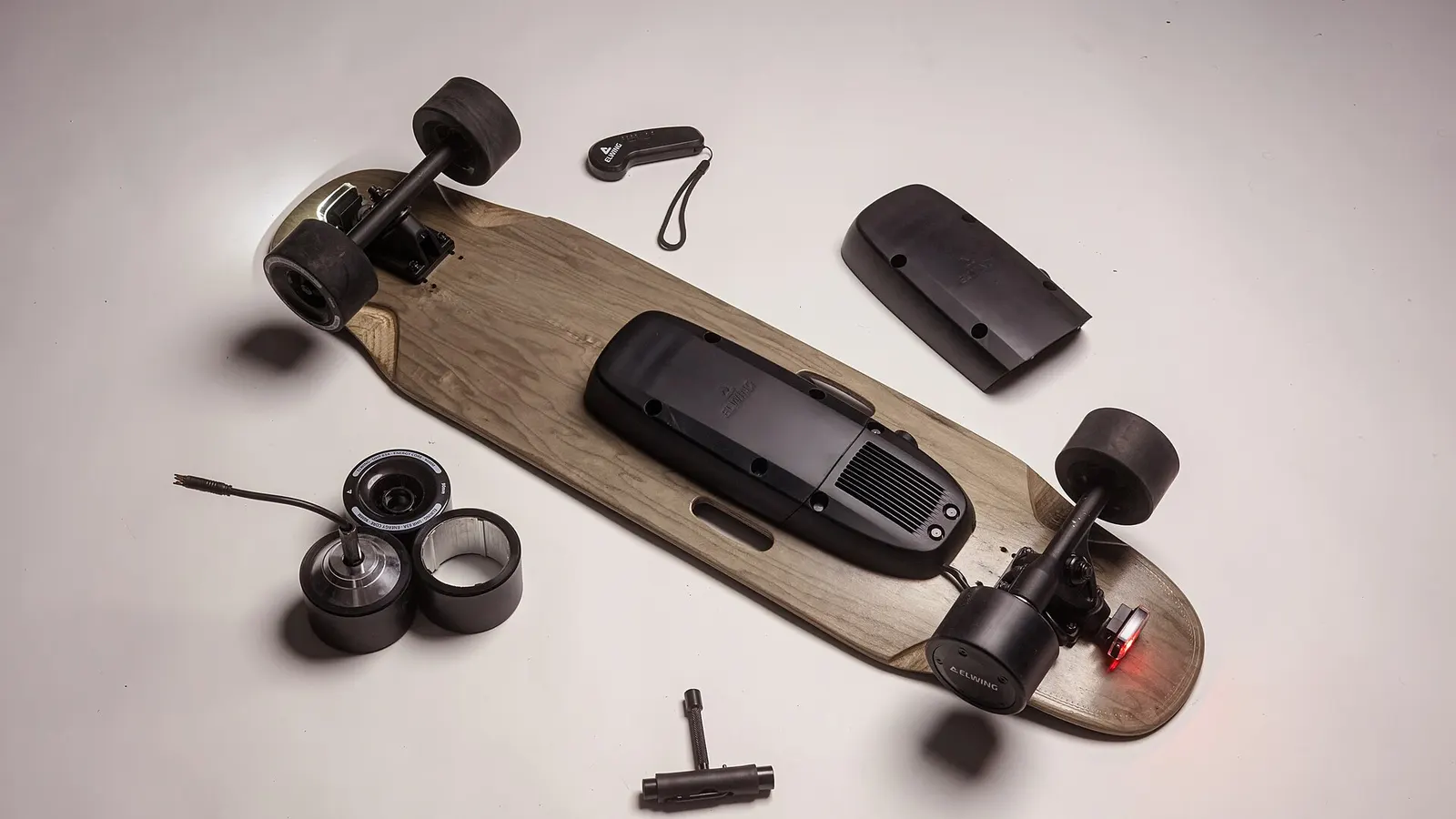
How battery capacity, motor power, rider weight, and terrain affect your electric skateboard range and top speed.
Every electric skateboard listing leads with two numbers: top speed and maximum range. Both are exaggerated. Understanding what actually determines real-world performance helps you make a better buying decision and avoid disappointment.
How Battery Capacity Determines Range
Battery capacity is measured in watt-hours (Wh). This is the single most reliable predictor of range. A 150 Wh battery stores less energy than a 300 Wh battery, and all else being equal, delivers roughly half the range.
Reading the spec sheet. Some manufacturers list battery capacity in Wh. Others list voltage (V) and amp-hours (Ah) separately. To calculate Wh, multiply voltage by amp-hours. A 36V 7.5Ah battery is 270 Wh. A 10S2P battery using Samsung 30Q cells at 36V nominal is about 216 Wh.
Typical ranges by capacity:
- 100 to 150 Wh: 8 to 15 km
- 150 to 250 Wh: 15 to 25 km
- 250 to 400 Wh: 25 to 40 km
- 400+ Wh: 40 km and beyond
These figures assume moderate speed on flat ground with an average-weight rider. Your actual range will vary.
Why Advertised Range Is Wrong
Manufacturers test range under ideal conditions: a lightweight test rider, flat terrain, constant moderate speed, no wind, warm weather, and a new battery. Real-world riding rarely matches these conditions.
Factors that reduce range:
Rider weight. A 90 kg rider will get significantly less range than a 65 kg rider on the same board. Heavier riders require more energy to accelerate and maintain speed, especially uphill.
Speed. Energy consumption increases roughly with the square of speed. Riding at 30 km/h uses much more energy per kilometre than riding at 20 km/h. If you ride at or near top speed constantly, expect 40 to 60 percent of the advertised range.
Hills. Climbing hills consumes far more energy than flat riding. A route with significant elevation change will cut your range substantially. Regenerative braking on descents recovers some energy, but not enough to offset the climbing cost.
Wind. A strong headwind has the same effect as riding uphill. Australia's coastal cities regularly see winds of 20 to 30 km/h, which can reduce your range by 15 to 25 percent.
Temperature. Lithium-ion batteries perform best at 20 to 25 degrees Celsius. Cold weather reduces available capacity temporarily. Extreme heat degrades cells over time. Most of Australia does not see the cold extremes that severely impact range, but hot summer days can still affect performance.
Tyre type. Pneumatic tyres create more rolling resistance than urethane wheels, reducing range by 10 to 20 percent compared to the same board on street wheels.
Battery age. Lithium-ion cells lose capacity over time and charge cycles. After 300 to 500 full charge cycles, expect the battery to hold 70 to 80 percent of its original capacity.
Acceleration and braking pattern. Stop-and-go riding in urban environments uses more energy than steady cruising. Frequent hard acceleration is particularly costly.
Real-World Range Estimation
A reasonable rule of thumb: take the manufacturer's stated range and reduce it by 25 to 35 percent for typical mixed riding conditions. If you are heavier than average, ride fast, or tackle hills, reduce it by 40 percent or more.
For commuting, plan your board to have at least 20 percent remaining battery when you arrive. This accounts for unexpected detours, headwinds, and the gradual capacity loss that occurs over the battery's lifespan.
Motor Power and Top Speed
Electric skateboard motors are rated in watts. You will see both peak wattage and continuous (or sustained) wattage.
Peak watts represent the maximum power the motor can deliver in short bursts, typically during hard acceleration or hill climbing. Peak figures are what manufacturers advertise.
Continuous watts represent what the motor can sustain without overheating. This figure is more relevant to real-world performance but is less commonly advertised.
Single vs dual motors. Dual motor boards deliver more power, better hill climbing, stronger braking, and often better traction. Single motor boards are lighter, cheaper, and adequate for flat terrain riding.
Common motor configurations:
- Single hub motor, 250 to 500W: Budget boards, flat terrain, 25 to 30 km/h top speed
- Dual hub motors, 500 to 1,000W total: Mid-range boards, moderate hills, 30 to 35 km/h
- Dual belt drive, 1,000 to 3,000W total: Performance boards, steep hills, 35 to 50 km/h
Top Speed vs Usable Speed
The advertised top speed of an electric skateboard is the maximum the board can achieve on flat ground with a lightweight rider in ideal conditions. For several reasons, you should not use this figure as your expected riding speed.
Safety. Riding an electric skateboard at 40 km/h or above requires significant skill and protective gear. A fall at this speed causes serious injury. Most riders cruise at 20 to 30 km/h regardless of their board's capability.
Stability. Speed wobbles become a real risk above 30 km/h on most boards, especially those with softer bushings or shorter wheelbases. Your board may be capable of 40 km/h, but that does not mean it is stable at 40 km/h.
Legal considerations. In Australian states that regulate personal mobility devices, speed limits of 25 km/h on shared paths are common. A board with a 45 km/h top speed offers no advantage if you are limited to 25 km/h by law.
Battery drain. Riding at top speed drains the battery much faster. A board with 30 km range at 20 km/h might only manage 15 km at its top speed.
For most riders, a board that cruises comfortably at 25 to 30 km/h is the practical sweet spot. It is fast enough for commuting, efficient enough for decent range, and manageable enough for safe riding.
Choosing the Right Battery for Your Needs
Short commute (under 5 km each way). A 150 Wh battery is sufficient with margin to spare. Boards in this range are lighter and cheaper.
Medium commute (5 to 10 km each way). Look for 200 to 300 Wh. This gives you comfortable range with a buffer for headwinds, detours, and battery degradation over time.
Long commute (10 to 20 km each way). You need 350 Wh or more. Boards in this range tend to be heavier and more expensive, but running out of battery mid-commute is worse than carrying extra weight.
Recreational riding. Range needs depend on your riding style. If you ride fast and aggressively, size up. If you cruise leisurely, a smaller battery may suffice.
Swappable Batteries
Some boards offer swappable battery packs. This effectively doubles or triples your range by carrying spare batteries.
The advantages are obvious: unlimited range with enough charged packs, and the ability to swap a degraded battery without replacing the entire board. The downsides are cost (each additional battery is a significant expense) and weight (carrying spare packs adds bulk).
If range is critical to your use case, a swappable battery system is worth the premium.
Charging Times and Practicalities
Standard chargers typically charge a battery from empty to full in 2 to 4 hours, depending on battery size.
Fast chargers reduce this to 1 to 2 hours but generate more heat, which is not ideal for long-term battery health. Use fast charging when you need it, standard charging when you have time.
Charging at work. If you commute on an electric skateboard, charging at your destination effectively doubles your usable range. A standard charger is small enough to carry in a backpack.
Partial charging. Lithium-ion batteries do not have a memory effect. You can top up from any charge level without harming the cells. In fact, partial charges (keeping the battery between 20 and 80 percent) are better for long-term health than full charge cycles.
The Numbers That Actually Matter
When shopping for an electric skateboard, focus on these numbers in order of importance:
- Watt-hours (Wh) of battery capacity, which determines real range
- Continuous motor wattage, which determines sustained performance
- Board weight, which affects portability and ride feel
- Wheel size and type, which affects ride comfort and terrain capability
Top speed and peak wattage are marketing numbers. They tell you the theoretical maximum, not the practical experience. A board with modest top speed numbers but a large battery, efficient motors, and quality wheels will outperform a board with impressive headline figures but a small battery and cheap components in every real-world scenario.
Ready to Roll?
Explore street and all-terrain electric skateboards and longboards, plus spare belts, wheels and chargers.
Shop Electric Skateboards →