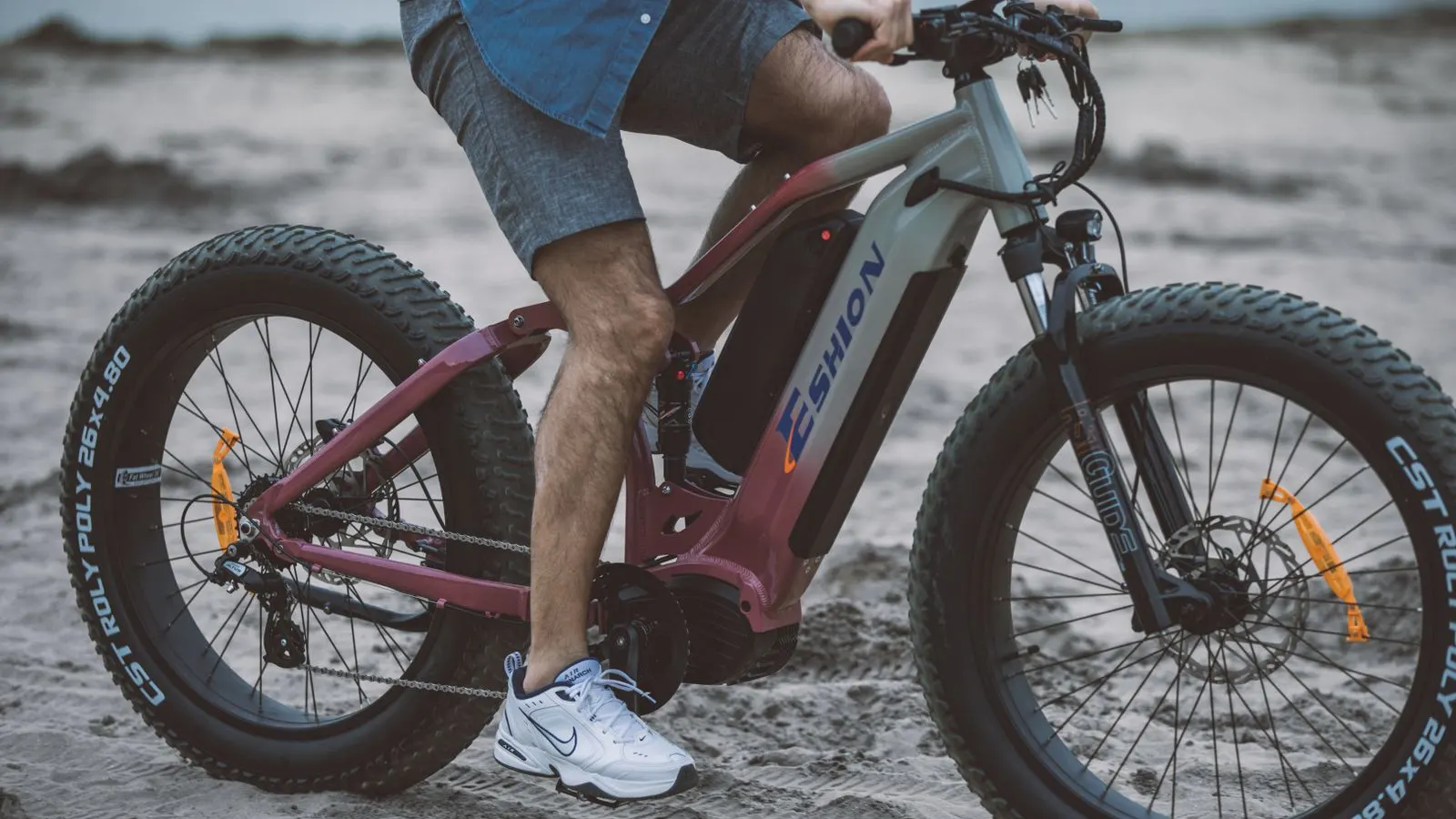
Why 4-inch fat tyres float on sand and gravel, how tyre pressure changes everything, and where to ride fat tyre e-bikes across Australia.
Fat tyre e-bikes were originally designed for snow and sand — surfaces where conventional narrow tyres sink and lose traction. In Australia, they have found a second life as all-terrain cruisers for beach tracks, fire trails, gravel paths, and relaxed urban riding.
What Makes a Tyre "Fat"?
Standard bike tyres are 28–42 mm wide. Fat tyres start at 3.8 inches (96 mm) and go up to 5.0 inches (127 mm). The contact patch — the area where rubber meets ground — is roughly four times larger than a standard tyre.
This extra contact area means:
- More traction on loose surfaces (sand, gravel, mud, wet grass)
- More cushioning — the large air volume acts as a natural suspension system
- More rolling resistance on hard surfaces — fat tyres are slower on sealed roads
- More weight — a fat tyre and wide rim weigh 2–3 kg more per wheel than standard
Where Fat Tyres Excel in Australia
Beach Riding
Australia has thousands of kilometres of coastal tracks, beach access paths, and sand flats. A regular e-bike sinks immediately. A fat tyre e-bike at low pressure (8–12 PSI) floats on top of packed sand and handles soft sections that would stop a regular bike.
Best for: beach access tracks, hard-packed sand at low tide, coastal paths mixing sand and gravel.
Not for: deep, dry, soft sand — even fat tyres bog down if the sand is loose enough. Stick to packed or damp surfaces.
Fire Trails and Gravel
Victoria, NSW, and Queensland have extensive fire trail networks that are open to cyclists. These unpaved roads suit fat tyres perfectly — the wide rubber handles loose gravel, washboard corrugations, and embedded rocks without the jarring ride of a narrow tyre.
Urban Cruising
Fat tyre e-bikes have become lifestyle bikes — the wide stance, relaxed geometry, and retro styling (think Super73 and similar moped-style designs) attract riders who want presence and comfort over speed. On smooth urban paths and suburban streets, a fat tyre cruiser rides like a small motorcycle without the registration or fuel costs.
Farm and Property Use
Rural properties, vineyards, orchards, and farms use fat tyre e-bikes as utility vehicles. The wide tyres handle paddock grass, gravel driveways, and mud without slipping, and the electric assist means you arrive without sweat.
What Fat Tyres Are Not Good At
- Speed on sealed roads: rolling resistance is higher. Expect 20–22 km/h cruising vs 25 km/h on a standard e-bike with the same motor.
- Long commutes: the extra drag means more battery consumption. A 500 Wh battery that gives 70 km on a standard e-bike may give 45–55 km on a fat tyre.
- Weight: fat tyre e-bikes typically weigh 28–35 kg. Carrying one upstairs or onto a train is impractical.
- Tyre replacement cost: fat tyres cost $50–$100 each vs $20–$40 for standard tyres. They are also harder to find locally — order online or stock a spare.
Tyre Pressure: The Key Variable
Fat tyre performance changes dramatically with pressure:
| Pressure | Surface | Ride feel |
|---|---|---|
| 5–10 PSI | Soft sand, snow | Maximum float, very slow on hard surfaces |
| 10–15 PSI | Gravel, dirt trails | Good traction, comfortable cushioning |
| 15–20 PSI | Mixed paths and roads | Balanced — some cushioning, less rolling resistance |
| 20–30 PSI | Sealed roads only | Firmest ride, lowest rolling resistance, least traction off-road |
If you ride mixed terrain (suburban streets to a beach track), start at 15 PSI and adjust based on the surface. Carry a small pump — dropping pressure at the trailhead and re-inflating for the road home makes a noticeable difference.
Motor and Battery Considerations
Fat tyre e-bikes need more power to overcome rolling resistance and push heavier frames:
- 500 W+ motors are the practical minimum. A 250 W motor on a 35 kg fat tyre bike will feel underpowered on hills.
- 48 V battery systems deliver more torque than 36 V equivalents — important for the extra drag.
- Battery capacity 500 Wh+ recommended. Fat tyres drain batteries 15–25 % faster than standard tyres at the same speed.
Most fat tyre e-bikes use rear hub motors — they are cheaper, simpler, and the direct-drive design handles the higher loads. Mid-drive options exist (like the Bafang M600 paired with fat tyres) but are less common and more expensive.
Choosing the Right Fat Tyre Width
- 3.8–4.0 inch: the narrowest "fat" option. Lighter, faster-rolling, still handles gravel and light sand. Best all-rounder if you also ride sealed roads.
- 4.5–4.8 inch: the most popular size. Good balance of float, traction, and weight.
- 5.0 inch: maximum float for deep sand and snow. Heaviest and slowest on hard surfaces. Only worth it if you ride soft surfaces regularly.
Bottom Line
Fat tyre e-bikes are purpose-built for loose surfaces and comfort cruising. They are not the fastest or lightest option, but on sand, gravel, and rough trails, nothing else comes close. If your riding includes any off-road component — even a short beach track on the weekend — a fat tyre e-bike opens up terrain that a standard bike simply cannot reach.
Ready to Find Your E-Bike?
Browse commuter, cargo, folding and mountain e-bikes from Brunswick, Victoria, with express freight across Australia.
Shop E-Bikes →