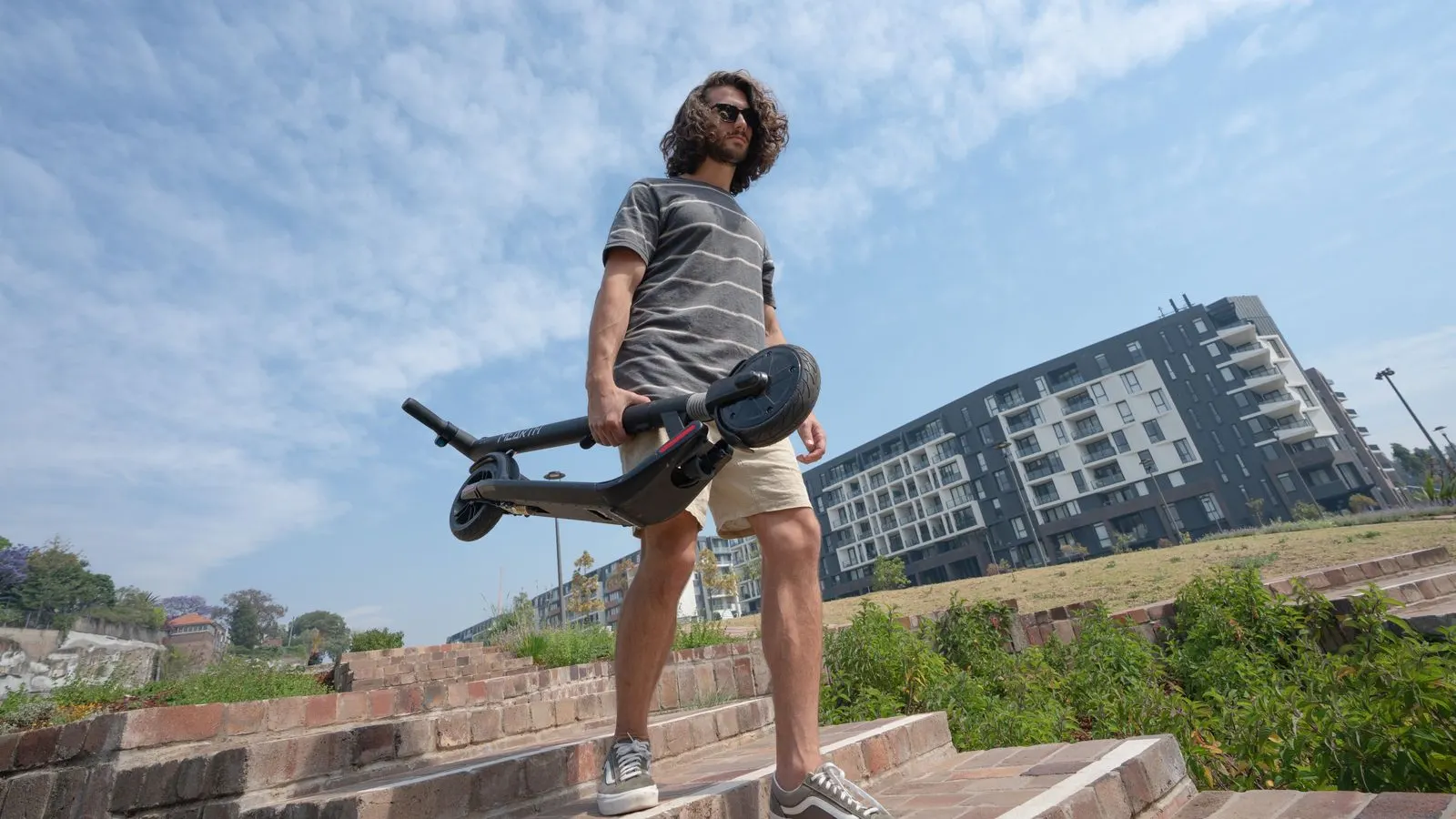
How a folding e-scooter solves the last-mile problem — fold times, weight limits, public transport rules, and the best lightweight models.
Folding E-Scooters for Last-Mile Commuting: Train, Bus, Weight, and Fold Time
For thousands of Australians, the hardest part of commuting is not the train or bus ride — it is getting from the station to the office. That last one to three kilometres can take 15 to 25 minutes on foot, which is longer than the train ride itself. A folding electric scooter solves this problem neatly, turning a frustrating walk into a three-minute ride. But not every e-scooter works well in this role. This guide covers what makes a scooter genuinely practical for multimodal commuting.
What Last-Mile Commuting Actually Looks Like
A typical multimodal commute in a city like Melbourne, Sydney, or Brisbane involves:
- Riding the scooter from home to the train station (1 to 3 km)
- Folding the scooter
- Carrying or rolling it through the station and onto the train
- Standing with it on the train for 20 to 40 minutes
- Unfolding at the destination station
- Riding to the office (1 to 3 km)
- Storing it at work
- Repeating the entire process in reverse
That is four fold/unfold cycles, two rides, and two carry periods per day. The scooter needs to handle every stage without being a burden. A scooter that rides beautifully but takes 30 seconds to fold and weighs 22 kg will make your commute worse, not better.
Weight: The Most Critical Factor
Weight determines whether a scooter is practical for multimodal commuting or merely theoretical. You will carry this thing up and down stairs, through ticket gates, along platforms, and through office corridors.
Under 12 kg: Genuinely easy to carry for most adults. You can hold it with one hand while using the other for a handrail or door. Scooters in this range typically have smaller batteries and motors, limiting range to 15 to 25 km and power to 250 to 350W. For short last-mile trips, this is often enough.
12 to 15 kg: Manageable for most people over short distances. You will feel it after carrying it up two flights of stairs, but it is not unreasonable. This weight range offers a better balance of range and portability, with 30 to 40 km range and 350 to 500W motors.
15 to 18 kg: The upper limit of what most people will tolerate carrying regularly. At this weight, a carry strap or shoulder bag for the scooter becomes essential. Some riders roll the scooter in its folded position rather than carrying it, which works on flat surfaces.
Over 18 kg: Not practical for daily carry. If you must navigate stairs, escalators, or narrow aisles, a scooter above this weight will become something you dread hauling around.
Test the weight yourself before buying. Pick up the scooter and walk 50 metres. Then imagine doing that twice a day, five days a week, while also carrying a bag.
Fold Mechanism: Speed, Simplicity, and Security
Not all folding mechanisms are equal. The fold needs to be fast, simple, and secure in both positions — fully locked for riding and fully locked for carrying.
Types of Fold
Lever-latch fold: The most common type. A lever at the base of the stem releases a latch, and the stem folds down onto the deck. Good designs fold in under 3 seconds and lock securely. Poor designs develop play over time, causing the stem to wobble while riding.
Twist-lock fold: A collar on the stem twists to release, then the stem folds. These can be very secure but are slower to operate, especially with cold or wet hands.
Button-release fold: A button or trigger releases the folding mechanism. Often found on lighter scooters. Quick to use but can wear out faster than lever systems.
Two-step fold: Some scooters require folding both the stem and the handlebars. This creates a more compact package but adds time and complexity.
What to Test
Before buying, fold and unfold the scooter at least five times. Time it. Can you do it in under 5 seconds? Can you do it with one hand? Does the folded position lock securely, or does it flop around?
Check the folded dimensions. Will it fit under your desk? In a train luggage rack? Between your legs while sitting on a bus?
A scooter with a poor folding mechanism will irritate you twice a day, every day. This is not a feature to compromise on.
Public Transport Rules in Australia
Each state has its own rules about e-scooters on public transport.
Sydney Trains and NSW buses: Folded e-scooters are permitted as long as they do not block aisles or doorways. They must be folded before entering the station.
Melbourne (Metro Trains and trams): Folded e-scooters are allowed. On trams, space is limited, so travel outside peak hours if possible.
Brisbane (TransLink): E-scooters are allowed on buses, trains, and ferries if folded and not obstructing other passengers.
Perth (Transperth): Folded e-scooters are allowed on trains and buses.
Adelaide (Adelaide Metro): Folded e-scooters are permitted on trains and buses.
The common requirement: the scooter must be folded. An unfolded scooter taking up standing space during peak hour will get you asked to leave. Compact folded dimensions and a quick fold time make compliance easy.
Some services may restrict e-scooters during extreme peak periods. Check your local transport authority's website for current rules.
Range Requirements for Last-Mile Use
Last-mile commutes are typically short: 1 to 5 km from each station to the final destination. A round trip of 2 to 10 km means even a modest battery will last several days between charges.
A scooter rated at 20 km range will comfortably handle a 3 km morning ride and a 3 km evening ride with ample reserve. You could potentially ride three to four days between charges.
Do not overbuy range for a last-mile scooter. A larger battery means more weight, which directly undermines the portability that makes last-mile commuting work. A 15 to 25 km range is typically sufficient.
If your total ride distance (home-to-station plus station-to-office, both ways) exceeds 15 km, you may need a scooter with more range, but at that point you are also carrying a heavier scooter on and off transport.
Features That Matter for Last-Mile Riders
Handlebar Height Adjustment
If the scooter is shared between household members, adjustable handlebars allow different riders to set a comfortable height. However, adjustable stems add weight and potential wobble points. If only one person uses the scooter, a fixed stem at the right height is more reliable.
Kickstand
A solid kickstand lets you park the scooter upright at your desk, in the office corner, or at the station while you buy coffee. A scooter without a kickstand needs to be leaned against something, which is precarious and annoying.
Carry Handle or Strap
Some scooters have a built-in carry handle on the stem or deck. Others work better with an aftermarket carry strap that loops around the stem and deck. Either way, a comfortable carrying solution is essential for daily hauling.
Deck Grip
A grippy deck surface keeps your feet planted during the ride and provides purchase when you carry the scooter with the deck against your body. Sandpaper-style grip tape works well but wears faster; rubberised deck surfaces last longer.
Lights
Even for short rides, lights are legally required after dark and practically essential during Australian winter commutes. Built-in lights that turn on automatically with the scooter are preferable to add-on lights you might forget.
A Practical Buying Checklist for Last-Mile Commuters
Run through these criteria when evaluating any scooter for train-and-scooter commuting:
- Weight under 15 kg (under 12 kg is ideal)
- Fold time under 5 seconds
- Folded dimensions fit under a standard office desk
- Range covers at least twice your total daily ride distance
- Tyres are at least 8 inches (10 inches preferred for comfort)
- Has at least one mechanical brake
- Built-in front and rear lights
- Solid kickstand
- Comfortable carrying method (handle or strap)
The Real Cost Saving
A monthly Opal card (Sydney), myki (Melbourne), or go card (Brisbane) combined with a folding scooter for last-mile legs is dramatically cheaper than driving and parking in the CBD. Parking alone in central Melbourne or Sydney costs $25 to $50 per day. A quality folding e-scooter pays for itself in saved parking within two to three months.
The time savings can be significant too. Walking 2 km from a station takes about 20 minutes. Riding takes 4 to 5 minutes. Over a year of commuting, that is roughly 130 hours saved — the equivalent of more than five full days.
Making It Work Long Term
The riders who successfully integrate e-scooters into their daily commute are the ones who minimise friction. Charge the scooter at work (keep a charger at the office). Store it under your desk, not in a distant locker. Practice the fold until it is automatic. Carry a small microfibre cloth to wipe the deck before tucking it beside your chair.
A folding e-scooter is not a replacement for public transport — it is the connector that makes public transport work for trips that were previously only practical by car. Get the weight and fold right, and you have a commuting system that is fast, cheap, and reliable.
Ready to Pick Your E-Scooter?
Compare commuter and long-range electric scooters, with accessories and spares, dispatched from Brunswick, Victoria.
Shop E-Scooters →